

NDI input
Introduction
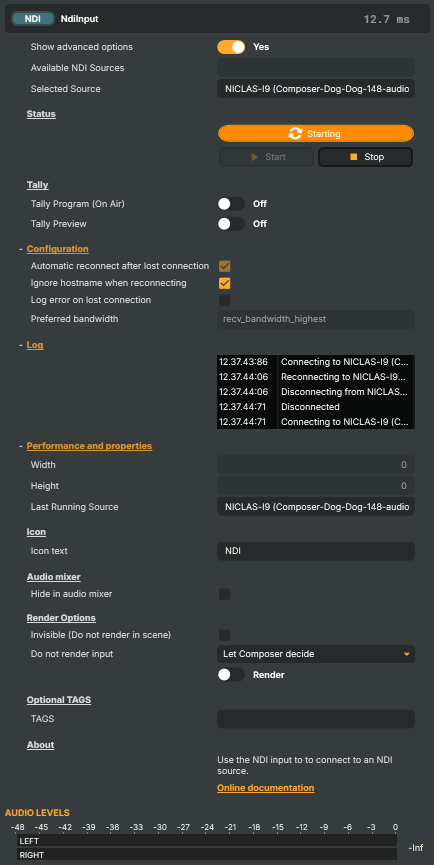
The NDI input receives a live video and audio stream from another NDI source on the local network — a camera, encoder, vision switcher, software production tool, or another Composer instance — and presents it inside Composer like any other input. Drop it on a layer and it composites, mixes, and routes through targets exactly the same way a Decklink capture or a video file would; the IP-network plumbing is hidden behind an automatic source picker.
What is NDI?
NDI (Network Device Interface) is the de-facto IP-based video transport for broadcast and live production. It was designed by NewTek (now part of Vizrt) and has become a near-universal way of moving studio-quality video and audio between machines on a normal Ethernet LAN — no SDI cables, no purpose-built capture cards in every receiver, no manual signal routing.
What makes NDI useful in a Composer studio:
- Low latency over a regular gigabit / 10 G Ethernet network — NDI's full-bandwidth mode keeps end-to-end delay in the low-frame range, comparable to baseband SDI for most workflows. The reduced-bandwidth NDI HX variants trade a few extra frames of latency for an order of magnitude less bandwidth, useful over cellular / WAN links.
- Automatic discovery — every NDI source on the same broadcast domain advertises itself via mDNS, so receivers can enumerate available sources without manual IP / port configuration. Composer's source picker is just a live view of that announcement table.
- Bidirectional metadata + tally — NDI carries small out-of-band signals alongside the video, including tally (red for Program, green for Preview). Composer feeds that back upstream so a remote NDI camera or software source can light its on-air indicator.
- Universal tooling — every modern broadcast tool speaks NDI: vMix, OBS, Wirecast, vision mixers, hardware cameras with NDI ports, software output from NLE timelines. Composer fits into that ecosystem natively.
- Free testing utilities — NewTek / Vizrt ship the NDI Tools bundle for free, including a Test Pattern Generator, Studio Monitor (a software receiver / monitor), Webcam Input (for converting a webcam to NDI), Scan Converter (any region of a screen as NDI), and more. Useful for validating a Composer NDI receiver / sender without needing a second physical machine.
For a deeper protocol-level reference (codecs, bandwidth modes, network requirements), see ndi.video.
Common use cases
- Multi-machine production — one host runs Composer for graphics + compositing, another host runs vision-mixing software, a third runs talkback / playout. Cameras and intermediate stages flow between them as NDI streams over the studio LAN.
- Software-camera ingest — bring in a laptop screen, a webcam, a remote Zoom / Teams call (via Vizrt's call connectors) as just another NDI source. No capture card needed.
- Cross-tool compatibility — receive feeds from any NDI-speaking switcher / encoder / camera regardless of vendor; NDI is the lingua franca that lets the brands interoperate.
- Composer-to-Composer hand-off — one Composer instance produces a multi-camera-mix + graphics rendering, another receives that as a single NDI source for additional downstream branding / re-encoding.
- Remote contribution from a VPN-connected machine — NDI HX over a managed VPN is a common low-friction way to bring a remote feed into a studio without building a dedicated SRT chain.
- Confidence monitoring during commissioning — pair the NDI input with the Test Pattern Generator from NDI Tools to verify the receive path end-to-end before a camera is connected.
Driving from outside
Every command (Start, Stop) is invokable from the property panel, the HTTP API (/api/invokecommand?targetname=NDI+Input&command=StartCommand), a Connector, or the Script Engine via ExecuteCommand / ExecuteCommandById. The selected source name and current playback state are surfaced as readable properties so dashboards and scripts can confirm the upstream feed is live without polling the network directly.
NDI input - Settings

| Property | Description |
|---|---|
Show advanced options |
Show or hide the input's advanced settings in the editor UI. [default=false]. |
Available NDI Sources |
Picker for NDI sources currently advertised on the local network. Updates automatically as sources come and go. Selecting one populates SelectedSource with the source's full name. Useful for choosing between multiple available feeds in the editor — scripts that drive the input headlessly typically set SelectedSource directly. |
Selected Source |
Full name of the NDI source the input is configured to receive. In NDI's standard MACHINE-NAME (Stream Name) format. Set this from a script to switch to a different NDI source — the input will connect on the next start, or immediately if already running and AutoReconnect is enabled. Required before StartCommand will run. |
Status
Status — current playback state and the start/stop commands.

| Property | Description |
|---|---|
PlaybackState |
Current playback state of the NDI receiver (read-only). Reflects whether the receiver is Stopped, Starting, Running, or in an error state. Driven indirectly by StartCommand and StopCommand. Read this from a script to decide whether the stream is live; it also drives the running indicator and the enabled state of the Start/Stop buttons. |
Start |
Start receiving the selected NDI source. |
Stop |
Stop receiving the NDI source. |
Tally
Tally — signal back to the upstream NDI source whether it's on Program or Preview.

| Property | Description |
|---|---|
Tally Program (On Air) |
(advanced) Whether the upstream NDI source is told it's on the Program (on-air) output. [default=false]. When true, this input notifies the source that its feed is currently live — typically causing a red tally light on the camera or encoder. Set from a script driving a switcher workflow so the talent / operator knows which camera is live. |
Tally Preview |
(advanced) Whether the upstream NDI source is told it's on the Preview (next) output. [default=false]. When true, this input notifies the source that its feed is queued to go live — typically causing a green tally light on the camera or encoder. |
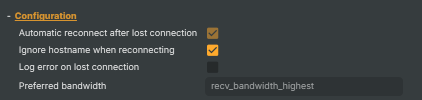
Configuration
Configuration — reconnect behaviour and bandwidth/quality preference.
| Property | Description |
|---|---|
Automatic reconnect after lost connection |
Whether the input automatically reconnects when the source disappears. [default=true]. When true, the input watches for the configured source to reappear on the network and resumes receiving without manual intervention. Useful when the upstream camera or encoder may briefly drop off the network during a production. |
Ignore hostname when reconnecting |
Whether reconnect matches by stream name only, ignoring the host machine name. [default=true]. NDI sources are normally identified by MACHINE-NAME (Stream Name). With this on, the input reconnects to a stream with the same name even if it now comes from a different machine — handy when a source is moved between encoders or workstations. Disable for strict reconnects that require the exact same machine. |
Log error on lost connection |
Whether a lost connection is logged as an error or as a warning. [default=true (error)]. When true, a dropped NDI source produces an error-level log entry — useful in productions where a missing feed is critical. Disable to log it as a softer warning when the source is expected to come and go. |
Preferred bandwidth |
(advanced) Quality / bandwidth trade-off when receiving the stream. [default=highest]. Highest requests the full-quality stream from the source. Lowest requests a low-bitrate thumbnail-style stream that's cheap to receive and decode — useful for monitoring many sources at once or running on constrained networks. The available levels depend on what the source publishes. |
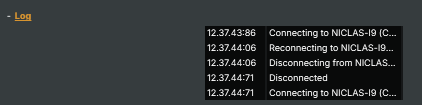
Log
Log — recent NDI events from the input.
| Property | Description |
|---|---|
ComponentLog |
Recent log lines from the input — connect, disconnect, reconnect, and error events (read-only). A short history of the most recent NDI events, useful for diagnosing why a source disappeared, why a reconnect attempt failed, or why the receiver couldn't start. |
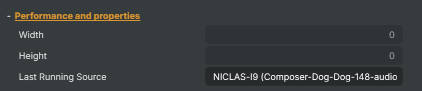
Performance and properties
Performance and properties — runtime stats about the live NDI stream.
| Property | Description |
|---|---|
Width |
Width of the video frames currently being received, in pixels (read-only). |
Height |
Height of the video frames currently being received, in pixels (read-only). |
Last Running Source |
Name of the NDI source the input most recently received frames from (read-only). Survives a disconnect, so it shows what was last working even when the source has dropped off the network. Used internally as the target for automatic reconnect. |
Inherits from: AbstractInput, AbstractAudioProcessing, AbstractAudioMetering.
See also: NDI input in Script Engine Objects.
Shared input properties
Every input — regardless of source type — exposes the following property groups. They are surfaced in the property panel only when Show advanced options is enabled on the input.
Icon
Icon text— short text shown on the input's icon in the Inputs list. Useful as a quick visual label (channel number, mic name, camera position) to tell otherwise-similar inputs apart at a glance. Empty by default; has no effect on rendering or routing.
Audio mixer
Hide in audio mixer— when on, hides the input from the audio mixer view without disabling its audio. Useful for de-cluttering the mixer while keeping the audio routed (e.g. fixed background music, ambient beds, pre-aligned playout). [default=false]
Render Options
Invisible (Do not render in scene)— when on, the input is skipped during rendering and produces no picture on any layer or scene. Audio routing is unaffected. Toggle from a script for cued-in / cued-out behaviour during a show. [default=false]Do not render input— disables the input's internal render entirely (no decode or capture work is done). Stronger than Invisible: that one renders but doesn't display; this one stops the input from doing any work at all. Useful for reducing CPU / network load on heavy sources (e.g. high-bitrate RTMP / SRT streams, large media files) when the input is temporarily not needed. Audio meters are cleared while disabled. [default=false]Do not render inputcontroller — chooses what drives the Do not render input flag.Let Composer decide(the default) hands control to the project-level Render Tuning optimiser, which automatically pauses inputs that aren't used by any active scene.Manual Configurationignores Render Tuning and lets the Do not render input toggle control the flag directly — use this to keep a network source warm even when it's currently off-air, or to take a heavy input down by hand regardless of scene activity. [default=Let Composer decide]
Optional TAGS
TAGS— one or more free-form tag words used to classify this input (typically space- or comma-separated). Picked up by Composer's Smart Search to filter or find inputs by category — e.g.camera,music,interview,sponsor. Has no effect on rendering.
Audio configuration and processing options
For inputs capable of processing audio, additional audio configuration and processing options are available through the audio mixer and the Channel Strip Inspector.
- Audio mixer — monitor levels, adjust gain and pan, mute / solo inputs, and configure auxiliary sends to
Audio Channel Stripsubmix buses, all from a centralised mixer-style interface. - Channel Strip Inspector — advanced per-strip audio processing for the selected input:
- Input trim, stereo remapping, and audio delay
- Channel mapping (8-channel mode unlocks the full MAPPING tab)
- Gate
- Low-cut filter
- Equaliser (5-band parametric)
- Compressor
- Sidechain ducking (a second compressor whose gain reduction is driven by another input's level — e.g. dipping music under a voice-over)
- Limiter
For the full audio signal flow, see Audio processing workflow.
Related components
- NDI Target — the sender-side counterpart. Use it when Composer publishes a scene to other NDI-aware tools rather than receiving one.
- SRT input — pick this when the contribution path leaves the studio LAN; SRT survives the kind of packet loss that breaks NDI, with bounded latency and optional encryption.
- SRT Target — the SRT sender-side for outbound contribution over unmanaged networks.
- RTMP input — pick this for managed-network ingestion from RTMP-only encoders; works across the public internet where NDI doesn't.
- RTMP Target — the RTMP sender-side. Use it to push a Composer scene out to a CDN or RTMP origin.
- MoQ input — pick this for sub-second-latency contribution from a Vindral CDN channel or other MoQ-native source.
- MoQ Target — the MoQ sender-side. Use it to publish a Composer scene into the Vindral CDN over MoQ.
- BlackMagic DeckLink Capture v3 — when the upstream signal is on baseband SDI / HDMI rather than NDI; same overall role in the project, different transport.