

Audio processing workflow
Audio in Composer flows through four discrete processing stages between an input and a target. Each stage owns a different concern, and the signal passes through them in order — so a decision you make early (say, gating out room noise on a guest mic) carries through everything downstream.
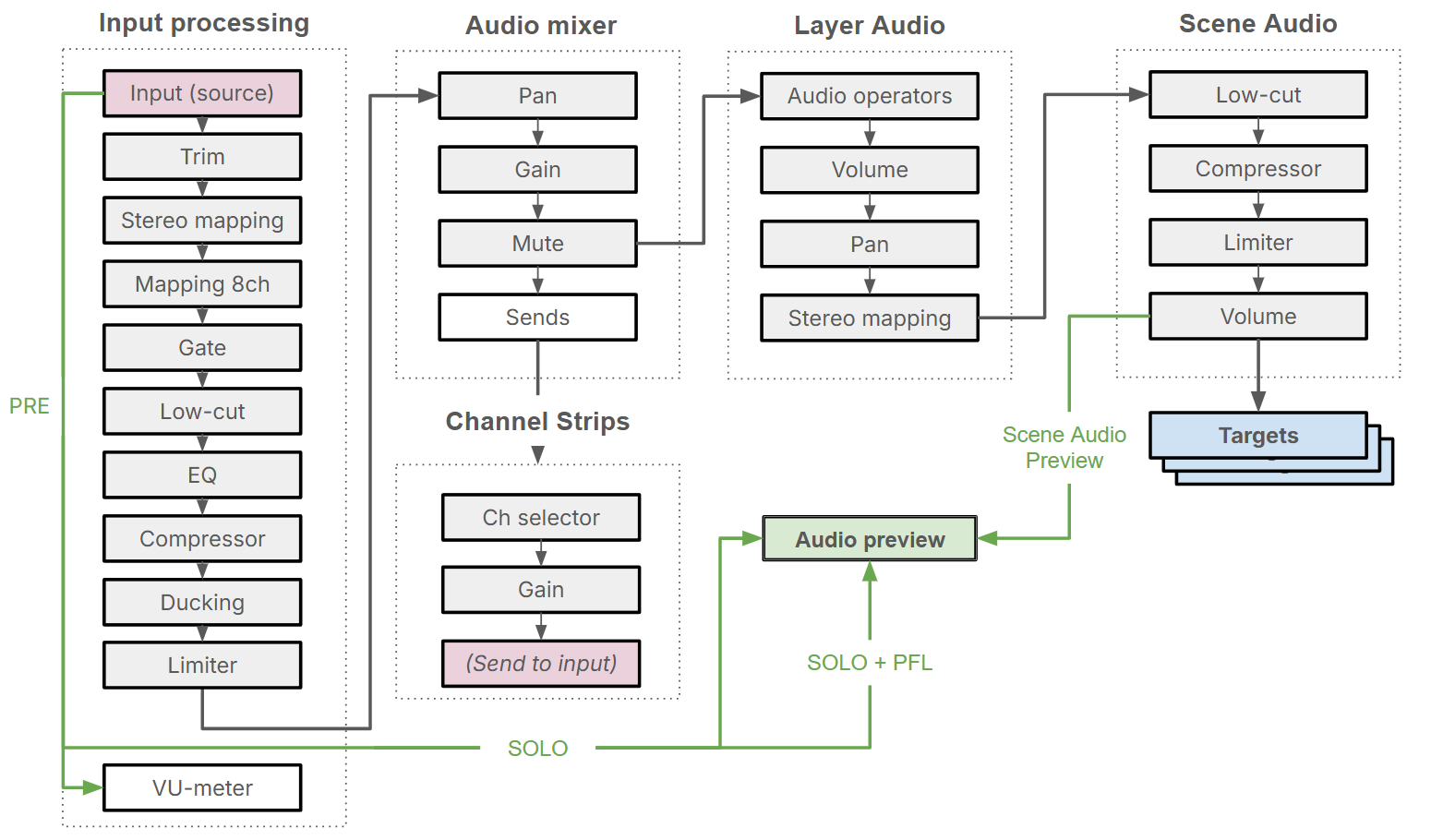
- Input processing — every audio-carrying input runs the per-input chain, in this fixed order: trim → stereo mapping → gate → low-cut → EQ → compressor → ducking (sidechain) → limiter. This is where you condition raw source audio (a noisy guest mic, a hot board feed) before it enters the project's mix. Treat it as the "channel strip" for the source: clean up problems here once, and every scene that uses the input inherits the cleaned-up signal.
- Audio mixer strip — each input bus appears as a strip in the mixer, with pan, gain, and mute controls. This is the mixing-console layer: where you balance levels between mic, music, and pre-recorded audio. The mixer is about relative loudness across sources, not about fixing any single source — that was step 1's job.
- Layer audio — when an input is used as a layer in a scene, the layer can apply its own operator stack, volume, pan, and stereo mapping. Layer audio is independent from the mixer strip — it lets a single source contribute differently to different scenes (full level in one scene, ducked or panned in another) without disturbing the source itself.
- Scene audio — the scene's combined audio runs through the scene's own chain (low-cut, compressor, limiter, master volume) before being handed to any target attached to the scene. This is the "master bus": the place for glue compression and a final safety limiter across the whole scene mix, not per-source surgery.
This four-stage architecture mirrors how live-sound rigs route audio: stage box (input chain) → console (mixer) → matrix (layer per scene) → master bus (scene output). The duplicate processing slots aren't redundancy — they let you control different concerns at different points (cleanup early, balancing in the middle, glue at the end). A good habit is to push each fix as far upstream as it sensibly goes: fix a source problem in the input chain, balance in the mixer, and reserve the scene chain for the final master.
Per-operator coverage
The chain stages above are built-in per-input processors. The Operators manual documents the matching standalone operator components — the ones you drop onto a layer — which share names with the chain stages but are separate objects you can place, stack, and automate independently.
For per-operator coverage of the audio processing operators — Gate, Low Cut, EQ (built-in as a 5-band parametric EQ in the input chain; the standalone equalizer operators are the 10-band and 3-band Equalizers), Compressor, Limiter, Sidechain Ducking, EBU R128, Frequency Analyzer, and Gain — see the Audio category in the Operators manual.