

EBU R128
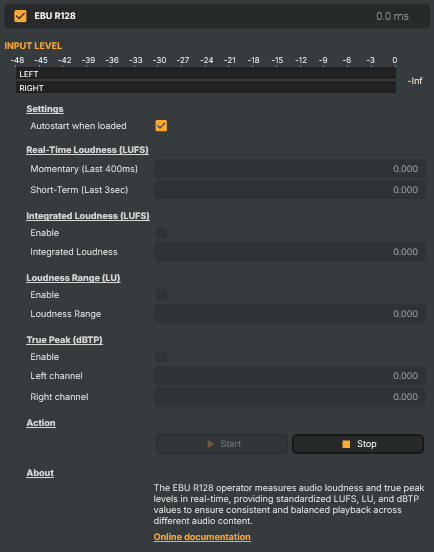
The EBU R128 operator measures the loudness of your audio in real time. Loudness describes how "loud" the sound feels to a listener, not just its technical volume level. This operator is purely analytical: it does not change or process the audio in any way — it only measures and reports values.
Why is this important?
Without control, some parts of your audio stream may sound much louder or quieter than others. This can be distracting for your audience and is not allowed in professional broadcasting.
The EBU R128 standard was created to solve this problem. It ensures that:
- Different parts of your production sound balanced and consistent.
- Your audio follows the loudness rules required in broadcasting.
- Listeners don't need to keep adjusting the volume when switching between programs.
With the EBU R128 operator in Composer, you can easily monitor whether your broadcast audio is consistent, comfortable to listen to, and compliant with broadcast standards.
Real-time vs integrated loudness
EBU R128 reports loudness in LUFS (Loudness Units Full Scale — the lower the number, the quieter the audio) and the operator surfaces two views of that number at the same time:
- Real-time loudness — what the audio sounds like right now. R128 defines two short windows: momentary loudness over the last 400 ms and short-term loudness over the last 3 s. Both update many times per second, so you can watch the values rise and fall as a presenter speaks, music plays, or a louder cue lands. Real-time readings are the meter you ride during the broadcast: spot the moment a guest leans into the mic, or a music bed drowns the dialogue, and act on it before viewers do.
- Integrated loudness — the average loudness of the entire programme so far. R128 specifies a gated mean over the whole measurement period (silence and very low passages are excluded by the gate, so they don't artificially pull the average down). The integrated value updates slowly — it represents minutes of audio, not milliseconds — and is the single number broadcasters quote when they say "this programme is at -23 LUFS". It is the value most regulators and platforms care about for compliance.
You use the two together: real-time loudness is your live monitoring instrument; integrated loudness is your delivery target. A typical workflow is to keep momentary / short-term sitting close to your house target during the show, and check at the end that integrated has landed within tolerance of the broadcast standard you're working to (commonly -23 LUFS for EBU broadcast, -16 LUFS for podcast, or -14 LUFS for many streaming platforms — set by the production, not by the operator).
Note
The EBU R128 operator only measures loudness — it never alters the signal. To bring loudness in line with a target value, pair it with the Limiter or Gain operators (or adjust your mix upstream). Use this operator's readings to guide those changes; don't expect it to do the levelling for you.
EBU R128 - Settings
Settings
Settings — load-time auto-start.

| Property | Description |
|---|---|
Autostart when loaded |
Whether the operator starts measuring as soon as the project loads. [default=true]. When true, the operator begins measuring automatically on load (equivalent to running StartCommand). Disable to require an explicit start, useful when you only want to measure a specific section of programme. |
Real-Time Loudness (LUFS)
Real-Time Loudness (LUFS) — short-window loudness readings that respond quickly to changes.

| Property | Description |
|---|---|
Momentary (Last 400ms) |
Loudness right now, averaged over the last 400 milliseconds, in LUFS (read-only). Reacts very quickly to level changes — useful for spotting momentary loudness spikes. |
Short-Term (Last 3sec) |
Loudness over the last 3 seconds, in LUFS (read-only). Smoother than Momentary — closer to the perceived loudness of a typical phrase or musical bar. Often the value broadcasters watch most closely during live operation. |
Integrated Loudness (LUFS)
Integrated Loudness (LUFS) — overall programme-level loudness from the start.

| Property | Description |
|---|---|
Enable |
Whether to measure integrated loudness. [default=false]. When true, the operator computes the EBU R128 integrated loudness — the standardised "average" loudness over the entire measurement period. Disable if you only need momentary or short-term readings to save a small amount of processing time. |
Integrated Loudness |
Overall programme loudness since the operator was started, in LUFS (read-only). The single value broadcasters compare against the loudness target (typically −23 LUFS for European broadcast, −16 LUFS for streaming). Only meaningful when EnableIntegratedLufs is true. |
Loudness Range (LU)
Loudness Range (LU) — how much the loudness varies between quiet and loud parts.

| Property | Description |
|---|---|
Enable |
Whether to measure the loudness range. [default=false]. When true, the operator computes the EBU R128 loudness range — a measure of the dynamics of the programme. Disable if you don't need the range value. |
Loudness Range |
Difference between the loudest and quietest parts of the programme, in LU (read-only). A high value means the programme is dynamic (orchestral music, drama with whispers and shouts); a low value means it's heavily compressed (commercials, pop music). Only meaningful when EnableRange is true. |
True Peak (dBTP)
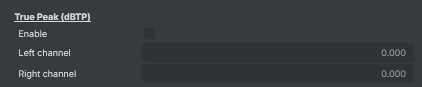
True Peak (dBTP) — highest sample-accurate peak levels per channel.
| Property | Description |
|---|---|
Enable |
Whether to measure per-channel true-peak levels. [default=false]. When true, the operator computes the true-peak levels using oversampling — the EBU R128 measurement that catches inter-sample peaks a normal sample-peak meter would miss. Important for catching clipping that only shows up after digital-to- analogue conversion or during lossy encoding. |
Left channel |
Highest true-peak level measured on the left channel since the operator was started, in dBTP (read-only). Should stay below the broadcast limit (typically −1 dBTP). Only meaningful when EnablePeak is true. |
Right channel |
Highest true-peak level measured on the right channel since the operator was started, in dBTP (read-only). See TruePeakLeftDbTp. |
Action
Action — start and stop measuring.

| Property | Description |
|---|---|
Start |
Start measuring loudness and true-peak levels. |
Stop |
Stop measuring and freeze the integrated loudness and loudness range at their final values. |
Inherits from: AbstractAudioOperator, AbstractOperator, AbstractAudioMetering.
See also: EBU R128 in Script Engine Objects.