

Web Page (Chromium, Windows)
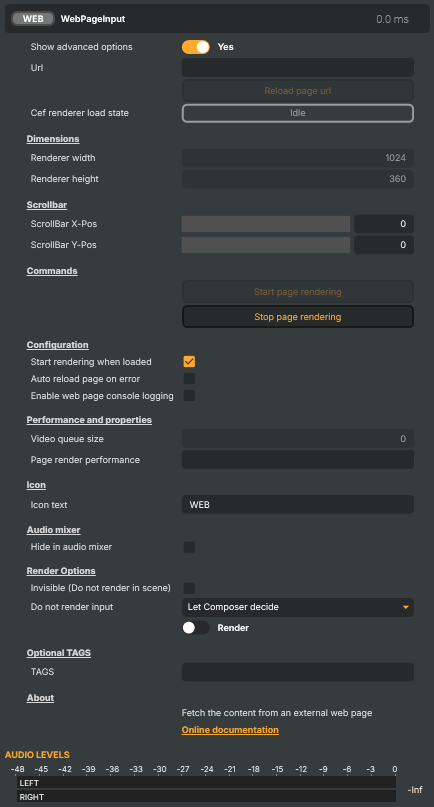
Renders a live web page as a video and audio source using a Windows-native Chromium-based browser (CefSharp). Point it at any HTTP/HTTPS URL — graphics overlays, scoreboards, dashboards, social-media feeds, or any other browser-renderable content — and Composer captures the page as a layer it can mix with the rest of the project. Includes auto-start on load, automatic reload on error, configurable resolution, scroll-bar control, and optional forwarding of the page's JavaScript console output to the log. Captures both video and audio from the page. Windows-only; for Linux or other platforms, use the cross-platform Web Page input instead.
Web Page (Chromium, Windows) - Settings
| Property | Description |
|---|---|
Show advanced options |
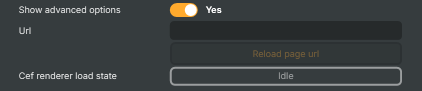
Show or hide the input's advanced settings in the editor UI. [default=false]. |
Url |
HTTP or HTTPS URL of the web page to render. Set to any standard web URL. Changing this from a script lets you swap the rendered page at runtime — handy for cycling through dashboards, scoreboards, or status pages. Set to an empty string to clear the page. |
Reload page url |
Reload the current page. |
Cef renderer load state |
Current browser state (read-only). Reflects whether the browser is idle, loading, or actively rendering. Driven indirectly by StartCommand, StopCommand, ReloadCommand, and the AutoStart behaviour at load time. Read this from a script to decide whether the page is live. |
Dimensions
Dimensions — width and height of the rendered page.

| Property | Description |
|---|---|
Renderer width |
Width of the rendered page, in pixels. [min=32, max=4096, default=1024]. Acts like the browser's viewport width. Pages adapt their layout to this size, so set it to match how you want the page to render. |
Renderer height |
Height of the rendered page, in pixels. [min=32, max=4096, default=360]. Acts like the browser's viewport height. Pages adapt their layout to this size, so set it to match how you want the page to render. |
Scrollbar
Scrollbar — programmatically scroll the rendered page.

| Property | Description |
|---|---|
ScrollBar X-Pos |
Horizontal scroll position of the page, in pixels. [min=0, max=50000, default=0]. Scrolls the rendered page left or right to a specific position. Useful for showing part of a wide page that wouldn't otherwise fit. Setting this calls window.scrollTo inside the page. |
ScrollBar Y-Pos |
Vertical scroll position of the page, in pixels. [min=0, max=50000, default=0]. Scrolls the rendered page up or down to a specific position. Useful for revealing content lower on the page or for animating a scroll over time from a script. Setting this calls window.scrollTo inside the page. |
Commands
Commands — start, stop, and reload the browser.

| Property | Description |
|---|---|
Start page rendering |
Start loading the URL and rendering the page. |
Stop page rendering |
Stop rendering the page. |
Configuration
Configuration — load-time and rendering options.

| Property | Description |
|---|---|
Start rendering when loaded |
Whether the input starts rendering as soon as the project loads. [default=false]. When true, the input invokes its start logic immediately on load (equivalent to running StartCommand). Disable to require an explicit start, useful when the page should only come live on operator action or via a script trigger. |
Auto reload page on error |
(advanced) Whether the page is automatically reloaded after a load error. [default=false]. When true, a failed load is retried automatically. Useful when the source server may be temporarily unavailable. Disable for one-shot loads that should not retry. |
Enable web page console logging |
(advanced) Whether messages logged by the page's JavaScript are written to Composer's log. [default=false]. Useful for debugging custom HTML overlays — console.log calls from the page show up alongside Composer's other log messages. |
Performance and properties
Performance and properties — runtime stats from the browser.

| Property | Description |
|---|---|
Video queue size |
Number of rendered frames currently buffered ahead of playback (read-only, debug). Should sit close to zero on a healthy system. A growing queue means the rest of the pipeline is consuming frames more slowly than the browser is producing them. |
Page render performance |
Recent per-frame rendering time, formatted as a millisecond string (read-only). Useful while monitoring how heavy the page is to render. Pages with complex animations or video elements take longer to render than static pages. |
Inherits from: AbstractInput, AbstractAudioProcessing, AbstractAudioMetering.
See also: Web Page (Chromium, Windows) in Script Engine Objects.
Shared input properties
Every input — regardless of source type — exposes the following property groups. They are surfaced in the property panel only when Show advanced options is enabled on the input.
Icon
Icon text— short text shown on the input's icon in the Inputs list. Useful as a quick visual label (channel number, mic name, camera position) to tell otherwise-similar inputs apart at a glance. Empty by default; has no effect on rendering or routing.
Audio mixer
Hide in audio mixer— when on, hides the input from the audio mixer view without disabling its audio. Useful for de-cluttering the mixer while keeping the audio routed (e.g. fixed background music, ambient beds, pre-aligned playout). [default=false]
Render Options
Invisible (Do not render in scene)— when on, the input is skipped during rendering and produces no picture on any layer or scene. Audio routing is unaffected. Toggle from a script for cued-in / cued-out behaviour during a show. [default=false]Do not render input— disables the input's internal render entirely (no decode or capture work is done). Stronger than Invisible: that one renders but doesn't display; this one stops the input from doing any work at all. Useful for reducing CPU / network load on heavy sources (e.g. high-bitrate RTMP / SRT streams, large media files) when the input is temporarily not needed. Audio meters are cleared while disabled. [default=false]Do not render inputcontroller — chooses what drives the Do not render input flag.Let Composer decide(the default) hands control to the project-level Render Tuning optimiser, which automatically pauses inputs that aren't used by any active scene.Manual Configurationignores Render Tuning and lets the Do not render input toggle control the flag directly — use this to keep a network source warm even when it's currently off-air, or to take a heavy input down by hand regardless of scene activity. [default=Let Composer decide]
Optional TAGS
TAGS— one or more free-form tag words used to classify this input (typically space- or comma-separated). Picked up by Composer's Smart Search to filter or find inputs by category — e.g.camera,music,interview,sponsor. Has no effect on rendering.
Audio configuration and processing options
For inputs capable of processing audio, additional audio configuration and processing options are available through the audio mixer and the Channel Strip Inspector.
- Audio mixer — monitor levels, adjust gain and pan, mute / solo inputs, and configure auxiliary sends to
Audio Channel Stripsubmix buses, all from a centralised mixer-style interface. - Channel Strip Inspector — advanced per-strip audio processing for the selected input:
- Input trim, stereo remapping, and audio delay
- Channel mapping (8-channel mode unlocks the full MAPPING tab)
- Gate
- Low-cut filter
- Equaliser (5-band parametric)
- Compressor
- Sidechain ducking (a second compressor whose gain reduction is driven by another input's level — e.g. dipping music under a voice-over)
- Limiter
For the full audio signal flow, see Audio processing workflow.