

Crystal Speech
The Crystal Speech Operator is an advanced AI-powered denoiser that enhances live audio streams by eliminating unwanted background noise in real time. Whether you're in a noisy environment or dealing with microphone interference, this feature ensures that only clear, high-quality speech comes through. By isolating voices and filtering out distractions, Crystal Speech delivers crisp, uninterrupted audio for a seamless listening experience.
Note!
Crystal Speech introduces a few frames of latency.
For optimal synchronization between audio and video, consider using the
Video Delayoperator in conjunction with Crystal Speech. This ensures that any audio processing delay introduced by Crystal Speech is matched by a corresponding video delay, keeping your audio and video in sync during live streams or recordings.
Audio Output and Mono Processing
To achieve the best noise reduction in real time, Crystal Speech processes audio in mono. By working with a single channel, it ensures clearer, more consistent speech while effectively eliminating unwanted background noise. This approach is standard in many high-performance denoisers, enabling efficient and precise noise filtering.
Note
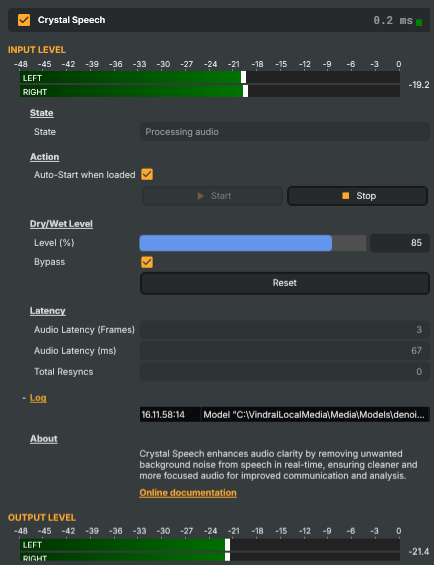
This operator displays the audio input level before processing and the output level after the operator has been applied, allowing you to monitor how the adjustments affect the signal.
A miniature audio meter (VU meter) in the header indicates incoming audio, so you can quickly verify that the operator is receiving audio even when it is collapsed.
Tip
Use the Audio tab in Settings to adjust how long the signal overload indicator stays active, and Project Options to change the maximum peak level displayed in all audio meters to your preference.
Related components
- Speech To Text — pair with Crystal Speech to feed the cleaner, denoised audio into Whisper for more accurate real-time transcription and subtitles.
- Text To Speech (ElevenLabs) — the inverse direction: turn scripted text into spoken audio in real time, useful for AI-driven announcements and presenter pipelines.
- Video Delay — compensate for the few frames of audio latency Crystal Speech introduces, keeping audio and video in sync.
Crystal Speech - Settings
State
State — current status of the noise-cancellation engine.

| Property | Description |
|---|---|
State |
Current operator state (read-only). Idle — model loaded, ready to process. Processing — actively cleaning audio. Stopped — manually stopped, audio passes through unchanged. ModelError — the noise-cancellation model failed to load (check the log for the file path the operator tried). RunError — a runtime failure occurred during processing. Useful from a script to react to state changes (e.g. send an alert if the state flips to RunError mid-show). |
Action
Action — start/stop the operator.

| Property | Description |
|---|---|
Auto-Start when loaded |
When true, the operator starts processing automatically once the project loads. [default=true]. The recommended setting for most projects — noise cancellation is on the moment the show begins. Disable to control activation manually (via StartCommand from a script or button), for example to enable cleanup only during certain segments. |
StartCommand |
Start the noise-cancellation engine. Switches OperatorState from Idle or Stopped to Processing. |
StopCommand |
Stop the noise-cancellation engine. The input audio passes through unchanged while stopped. |
Dry/Wet Level
Dry/Wet Level — blend between the original and the cleaned signal.
| Property | Description |
|---|---|
Level (%) |
Mix between the original audio (dry) and the noise-cancelled audio (wet), in percent. [min=0, max=100, default=85]. 0 outputs the original unchanged. 100 outputs only the cleaned signal. Mid values blend the two — useful when full denoising sounds too "processed", strips natural room ambience, or makes a voice feel disconnected from the scene. Uses an equal- power crossfade so perceived loudness stays roughly constant across the slider. |
Bypass |
When true, outputs the original audio unchanged — the cleaned signal is ignored. [default=false]. Quick A/B comparison toggle — turn on to hear the raw source, off to hear the cleaned result. The engine keeps running in the background either way, so the switch is instant and there's no glitch when toggling on air. |
ResetCommand |
Reset Dry/Wet level and Bypass to their defaults (85%, off). |
Latency
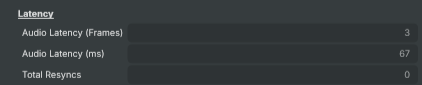
Latency — extra delay introduced by the noise-cancellation processing.
| Property | Description |
|---|---|
Audio Latency (Frames) |
Processing delay measured in audio frames (read-only). Reflects how many frames the engine buffers internally before output is available. To keep other audio paths time-aligned with the cleaned signal, apply a matching delay (using the Delay operator) on the parallel branches. |
Audio Latency (ms) |
Processing delay in milliseconds (read-only). Same delay as AudioLatencyFrames, expressed as time. Measured once on first startup and reused on subsequent stop/start cycles, so the value stays stable throughout a session. |
Total Resyncs |
Number of times the audio buffer has had to resync since processing started (read-only). A resync happens when the engine falls behind and the buffer overflows — typically caused by a load spike on the host or a debugger pause. The occasional resync is harmless; frequent ones indicate the host is overloaded — reduce other work on the machine or move the cleanup elsewhere. Useful from a script to alert when the count climbs unexpectedly. |
Log
Log — recent component messages and warnings.

| Property | Description |
|---|---|
ComponentLog |
Inherits from: AbstractAudioOperator, AbstractOperator, AbstractAudioMetering.
See also: Crystal Speech in Script Engine Objects.