

Compressor V2
Introduction
Compressor V2 evens out the dynamic range of an audio signal — it automatically turns down the loud parts so the quiet parts don't get lost underneath them. The result is a steadier, more controlled sound: a presenter who leans into the mic no longer jumps out, a music bed that swells no longer buries the dialogue, and the overall level sits in a tighter, more broadcast-friendly window.
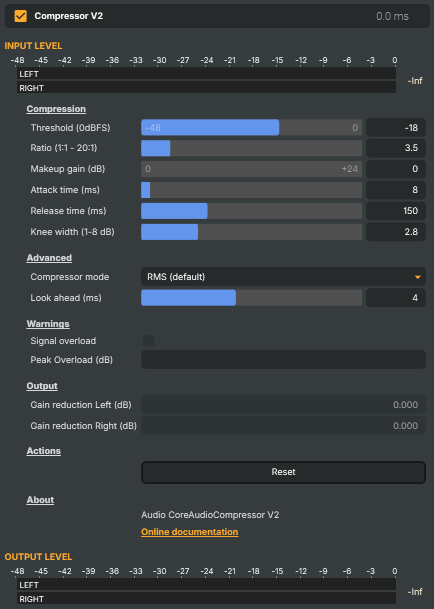
It is the recommended compressor for new projects. Alongside the standard controls — threshold, ratio, attack/release, knee, and makeup gain — it adds two things the original Compressor doesn't have: look-ahead, so gain reduction lands exactly on a transient instead of slightly after it, and live gain-reduction meters, so you can see how hard the compressor is working at any moment rather than guessing by ear. The defaults are a sensible broadcast starting point, and Reset returns to them at any time.
How it works
Every moment, the compressor compares the incoming level against the Threshold. Audio below the threshold passes through untouched; audio above it is pulled down according to the Ratio. A 4:1 ratio means that for every 4 dB the input rises above the threshold, the output only rises by 1 dB. Because compression lowers the overall level, you then add Makeup gain to bring the perceived loudness back up — so the signal sounds fuller and more consistent rather than simply quieter.
The controls are grouped into sections that follow the signal through the operator.
Compression
These are the main controls that shape how the compressor reacts:
- Threshold (0dBFS) (
-48…0, default-18) — the level above which compression starts. Audio louder than this is reduced; audio quieter is left alone. Lower (more negative) values catch more of the signal; values close to0only catch the loudest peaks. - Ratio (1:1 - 20:1) (
1…20, default3.5) — how strongly audio above the threshold is reduced.1:1is no compression,2:1is gentle,4:1is a typical broadcast setting, and10:1or higher starts to behave like a limiter. - Makeup gain (dB) (
0…24, default0) — extra level added after compression to compensate for the reduction. Set it so the signal sounds roughly the same loudness with the compressor bypassed and engaged. - Attack time (ms) (
0…200, default8) — how quickly the compressor clamps down once the signal crosses the threshold. Short values catch fast transients (drums, hard consonants) but can sound "squashed"; longer values let the initial punch of a sound through before gain reduction sets in. - Release time (ms) (
0…500, default150) — how quickly the compressor lets go after the signal drops back below the threshold. Short values recover quickly and stay transparent on speech; long values keep the gain reduction smooth across a phrase. - Knee width (1-8 dB) (
1…8, default2.8) — how gradually compression engages around the threshold. A narrow knee gives a hard, punchy onset (good for limiting); a wide knee eases the compressor in for a soft, gentle engagement (good for vocals and music).
Advanced
- Compressor mode — how the compressor measures level. Peak reacts to instantaneous peaks and is more aggressive on transients; Rms reacts to the smoothed, perceived loudness over time and is gentler and more transparent on voices and music. Rms is the default.
- Look ahead (ms) (
1…8, default4) — how far ahead the compressor anticipates the signal before applying gain reduction. This lets it engage right as a transient arrives instead of a moment late, which catches sharp peaks cleanly. It adds a small, constant amount of latency equal to this value.
Warnings
If the combined effect of compression and makeup gain pushes the output past full scale, Signal overload lights up and Peak Overload (dB) records the highest level reached. Both auto-reset after two seconds. An overload that keeps tripping means your makeup gain is too high for the material — pull it back until the indicator stays clear.
Output
Two live meters show how hard the compressor is working right now, per channel:
- Gain reduction Left (dB) and Gain reduction Right (dB) — the amount each channel is currently being attenuated, smoothed over a short window for a stable readout.
0means no compression is happening at that instant; more negative values mean the compressor is pulling the level down harder. Watch them to confirm the compressor is actually engaging on the loud parts and resting on the quiet ones — if they sit pinned at a large reduction the whole time, the threshold is probably too low or the ratio too high; if they never move, the threshold is too high to catch anything. An outgoing VU meter on the operator shows the resulting level after processing.
Common use cases
- Smoothing a presenter or commentator — a moderate threshold with a
3:1–4:1ratio, RMS mode, and gentle makeup gain keeps a voice sitting at a steady level whether the speaker whispers or shouts. Watch the gain-reduction meters dip on the loud words. - Taming a dynamic music bed — compress the music so its loudest passages no longer fight the dialogue, then bring the makeup gain up to set the bed cleanly under the voice.
- Catching peaks before a target — a higher ratio with a fast attack and a few milliseconds of look-ahead acts as a safety clamp on transients ahead of an encoder or stream, complementing the Limiter for hard ceiling control.
- Tightening a full mix — a wide knee, RMS mode, and a low ratio add density and consistency to a complete mix without an obviously "compressed" sound.
To measure loudness rather than shape it, pair Compressor V2 with the EBU R128 operator; for a simple level change with no dynamics processing, use Gain. If you need parallel (wet/dry) compression, upward compression, or per-channel link control, the original Compressor exposes those options.
Compressor V2 - Settings
Properties marked (
Components) or (AudioMixer) broadcast a livePropertyChangedevent to clients subscribed to that WebSocket channel.
Compression
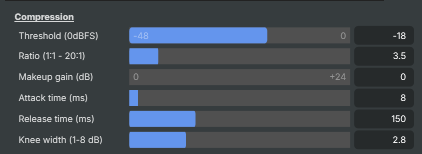
Compression — the main controls that shape how the compressor reacts.
| Property | Description |
|---|---|
Threshold (0dBFS) |
Level above which the compressor starts working, in decibels relative to full scale. [min=-48, max=0, default=-18]. Audio louder than this gets reduced by Ratio; audio quieter than this is left unchanged. Lower (more negative) values catch more of the signal; values close to 0 only catch the loudest peaks. |
Ratio (1:1 - 20:1) |
How strongly audio above the threshold is reduced. [min=1, max=20, default=3.5]. Expressed as N:1. 1:1 is no compression; 2:1 means every 2 dB above threshold becomes 1 dB at the output (gentle); 4:1 is a typical broadcast setting; 10:1 or higher acts like a limiter. |
Makeup gain (dB) |
Extra gain applied after compression to compensate for the level reduction. [min=0, max=24, default=0]. Compression always lowers the overall level; makeup gain brings the perceived loudness back up. Set so the compressor's bypassed and engaged levels sound roughly equal. |
Attack time (ms) |
How quickly the compressor reacts when the signal exceeds the threshold, in milliseconds. [min=0, max=200, default=8]. Short values catch fast transients (drums, hard consonants) but can sound "squashed". Longer values let initial peaks through before the gain reduction kicks in, preserving punch. |
Release time (ms) |
How quickly the compressor stops working after the signal drops below the threshold, in milliseconds. [min=0, max=500, default=150]. Short values let the compressor recover quickly (more transparent on speech); long values keep the gain reduction smooth across phrases. |
Knee width (1-8 dB) |
Soft-knee width around the threshold, in decibels. [min=1, max=8, default=2.8]. Controls how gradually the compressor engages near the threshold. Low values give a hard, punchy onset (good for limiting); high values give a soft, gentle engagement (good for vocals and music). |
Advanced
Advanced — detector type and look-ahead time.

| Property | Description |
|---|---|
Compressor mode |
AudioCompressorDetectorMode — how the compressor measures the input level. [default=Rms]. Peak reacts to instantaneous peaks (more aggressive on transients). Rms reacts to the smoothed loudness over time (more transparent on voices and music). |
Look ahead (ms) |
How far ahead the compressor "looks" before applying gain reduction, in milliseconds. [min=1, max=8, default=4]. Lets the compressor anticipate transients so the gain reduction engages right when they arrive instead of slightly after. Adds a small constant amount of latency equal to this value. |
Warnings
Warnings — clip indicators that flag when the signal is too loud.

| Property | Description |
|---|---|
Signal overload |
True when the compressor's output signal has clipped (read-only). Lights up when the combined effect of compression and MakeupGainDb pushes the signal above full scale. Auto-resets after 2 seconds. Reduce MakeupGainDb if this trips often. |
Peak Overload (dB) |
Highest level reached during the most recent overload, in decibels (read-only). Updated whenever SignalOverLoad trips, and auto-resets after 2 seconds. |
Output
Output — live gain-reduction meters showing how hard the compressor is working.

| Property | Description |
|---|---|
Gain reduction Left (dB) (AudioMixer) |
How much the left channel is being attenuated right now, in decibels (read-only). Smoothed over 300 ms for a stable readout. 0 means no compression is happening; more negative values mean the compressor is working harder. |
Gain reduction Right (dB) (AudioMixer) |
How much the right channel is being attenuated right now, in decibels (read-only). See GainReductionMeterL. |
Actions
Actions — one-click commands.

| Property | Description |
|---|---|
Reset |
Reset all settings to their broadcast-style defaults. Restores threshold, ratio, attack/release, knee, makeup gain, look-ahead, and detector mode to a sensible starting point for general-purpose compression. |
Inherits from: AbstractAudioOperator, AbstractOperator, AbstractAudioMetering.
See also: Compressor V2 in Script Engine Objects.