

Google Storage Target
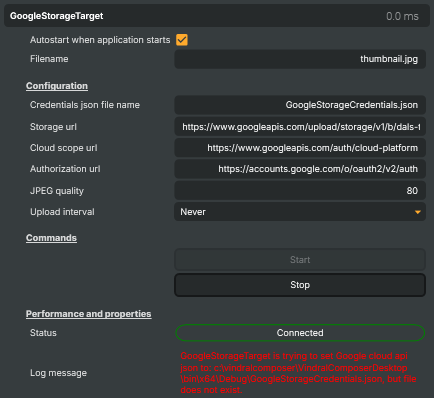
Periodically uploads a JPEG of the composed scene to a Google Cloud Storage bucket. Useful for publishing a live thumbnail to a public web page, feeding monitoring dashboards in the cloud, archiving stills off-site for compliance, sharing previews with remote collaborators, or driving social-media auto-posters that pick up new images from a known URL. Authentication uses a Google service-account JSON key file referenced by CredentialsFileName. Keep the key file out of project files / version control — point to it by path or supply it through your environment. Uploads run on a background task; failures are retried, and recurring errors are logged so the operator notices.
Google Storage Target - Settings

| Property | Description |
|---|---|
Autostart when application starts |
When true, uploading begins automatically as soon as the application starts. Recommended for unattended installations where you want a continuously refreshed thumbnail in the cloud. |
Filename |
Object name (file name) used when uploading the image to the Google Cloud Storage bucket. A constant name like thumbnail.jpg keeps overwriting the same object — best for a "live preview" thumbnail that web pages reload regularly. Use a name with a timestamp or counter if you want to keep history. |
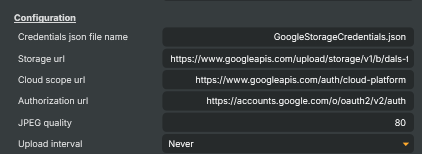
Configuration
Configuration section — credentials, bucket URL, image quality and upload cadence.
| Property | Description |
|---|---|
Credentials json file name |
Path to a Google service-account JSON key file that grants write access to the target bucket. Resolved relative to the application's working directory if not absolute. Keep the key file out of project files and version control — store it next to the application or reference a path provided via configuration or environment. Without a valid key file the target cannot start uploading. |
Storage url |
Full Google Cloud Storage upload URL up to and including name=, e.g. https://www.googleapis.com/upload/storage/v1/b/<bucket>/o?uploadType=media&name=. The current Filename is appended to this URL for each upload. The bucket must already exist and the credentials must allow the storage.objects.create permission on it. |
Cloud scope url |
OAuth 2.0 scope used when authorising the service account. The default value https://www.googleapis.com/auth/cloud-platform is correct for almost all use cases and rarely needs to be changed. |
Authorization url |
OAuth 2.0 authorisation endpoint used when requesting access tokens. The default value https://accounts.google.com/o/oauth2/v2/auth is correct for standard Google Cloud service accounts and rarely needs to be changed. |
JPEG quality |
JPEG compression quality for the uploaded thumbnail. [min=10, max=100, default=80]. Higher values produce sharper images at the cost of larger uploads — pick the lowest value that still looks acceptable to keep bandwidth and storage cost down. |
Upload interval |
How often a fresh image is uploaded to the bucket — every 1, 2, 5, 10, 20, 30 or 60 seconds. Set to Never to disable uploads without stopping the target. Pick the longest interval that still gives timely-enough thumbnails — frequent uploads cost bandwidth and incur per-request charges in GCP. |
Commands
Commands section — start and stop uploads.

| Property | Description |
|---|---|
Start |
Start uploading thumbnails to the configured bucket. The credentials file is loaded the first time an upload is attempted; if loading fails, the target reports the error in Minilog. |
Stop |
Stop uploading. Any upload already in flight is allowed to finish; no new uploads are scheduled until StartCommand is called again. |
Performance and properties
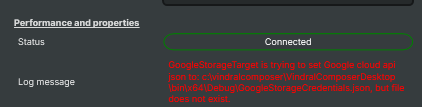
Performance and properties section — current connection status and the most recent log message.
| Property | Description |
|---|---|
Status |
Current upload status: Connected while uploads are active, Disconnected while stopped (read-only). Useful in scripts to confirm the target started successfully before issuing other commands. |
Log message |
Most recent status message from the upload worker, including informational, warning and error messages (read-only). Surface this in dashboards or scripts to spot upload problems early — repeated failures (5 in a row) are escalated to errors and logged. |
Inherits from: AbstractTarget.