

Audio Router
Introduction
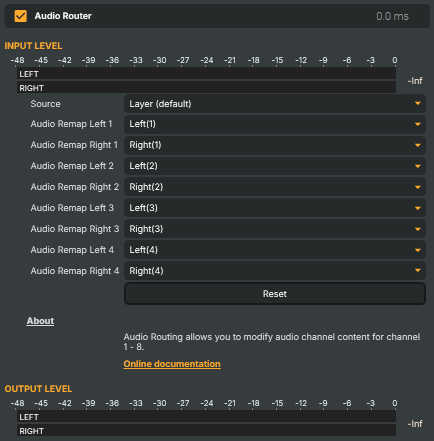
The Audio Router rewires the layer's audio at the channel level. For each of the eight output channels you pick which of the eight input channels feeds it — or set it to None to silence that output. The same input channel can feed several outputs, channels can be reordered freely, and any combination of mute / duplicate / swap is just eight dropdowns away.
By default the operator passes the layer's audio through untouched (output channel N = input channel N), so dropping the router into a scene has no audible effect until you actually change a mapping. A single Reset command snaps every output back to that identity routing — useful as a known starting point when you're scripting a new mapping.
Source selection
The Source property picks where the operator reads audio from:
- Layer (default) — reads the layer's regular audio output, after the layer's gain, mute, and any preceding audio operators have already been applied. The natural choice when you want to rewire what the layer would normally emit.
- Source pre-fader — reads the layer's original input audio before any layer-level processing. Useful when you need the raw source channels regardless of how the layer's main audio is mixed down (for example, sending a clean per-mic split out to a recorder while the layer's mixed audio continues to feed the program).
Common use cases
- Swap channels — a contribution feed arrives with left and right inverted, or with the commentary on channels 3/4 instead of 1/2. Two dropdowns reorder it; nothing downstream has to know.
- Duplicate one source onto several outputs — send a mono interview mic out as channels 1/2 and as channels 5/6 to feed a second downstream tool that expects audio on a different pair.
- Mute specific channels — silence the international audio pair on a feed bound for the domestic mix, or kill an empty channel pair before it reaches the meters.
- Rearrange a multi-channel feed for downstream equipment — match the channel order a target encoder, NDI receiver, or SDI router expects without having to reconfigure the source.
- Repair a mis-wired contribution — when the upstream encoder put the wrong mic on the wrong channel, route around the mistake here rather than chasing the operator on the other end mid-show.
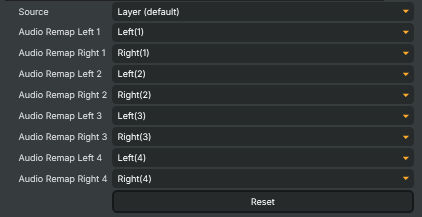
The eight output channels appear as four labelled pairs (Left 1 / Right 1 through Left 4 / Right 4), matching how Composer presents multi-channel audio elsewhere in the property panel.
Audio Router - Settings
| Property | Description |
|---|---|
Source |
Which audio to route from. [default=Layer]. Layer routes from the layer's regular audio output (after the layer's gain, mute, and other audio operators have been applied). SourcePreFader routes from the layer's original input audio before any layer-level processing — useful when you need the raw source channels regardless of how the layer's main audio is mixed. |
Audio Remap Left 1 |
Which input channel feeds output channel 1 (Left of pair 1). [default=Left1]. Pick any of the eight input channels (Left1–Right4) to copy into output channel 1, or None to silence the output. Combined with the other seven remap properties to build any 8-to-8 channel routing. |
Audio Remap Right 1 |
Which input channel feeds output channel 2 (Right of pair 1). [default=Right1]. |
Audio Remap Left 2 |
Which input channel feeds output channel 3 (Left of pair 2). [default=Left2]. |
Audio Remap Right 2 |
Which input channel feeds output channel 4 (Right of pair 2). [default=Right2]. |
Audio Remap Left 3 |
Which input channel feeds output channel 5 (Left of pair 3). [default=Left3]. |
Audio Remap Right 3 |
Which input channel feeds output channel 6 (Right of pair 3). [default=Right3]. |
Audio Remap Left 4 |
Which input channel feeds output channel 7 (Left of pair 4). [default=Left4]. |
Audio Remap Right 4 |
Which input channel feeds output channel 8 (Right of pair 4). [default=Right4]. |
Reset |
Reset all remap settings to their identity mapping (each output gets the input channel of the same name). Useful from a script that wants a known starting state before applying a new routing. |
Inherits from: AbstractAudioOperator, AbstractOperator, AbstractAudioMetering.
See also: Audio Router in Script Engine Objects.