

Audio Monitor
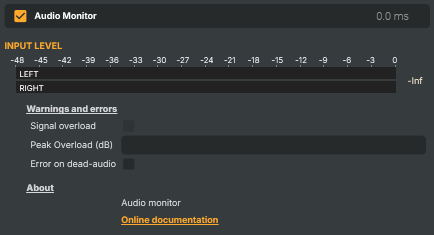
Watches an audio stream for signal overload (clipping) and prolonged silence (dead audio), without changing the audio in any way. Useful as a passive watchdog inserted into an audio chain — it reports problems through its SignalOverLoad indicator and can fire a log error when no audio has been heard for 10 seconds. Place it after gain stages, equalizers, or compressors to verify the resulting signal stays within safe levels.
Audio Monitor - Settings
Warnings and errors
Warnings and errors — clip and silence indicators.

| Property | Description |
|---|---|
Signal overload |
True when the input audio signal has clipped (read-only). Lights up when any sample exceeds full scale (i.e. peaks above 0 dBFS). Auto-resets after 2 seconds. Read this from a script to react to overload — for example, log an alert or trigger an attenuator further upstream. |
Peak Overload (dB) |
Highest level reached during the most recent overload, in decibels (read-only). Updated whenever SignalOverLoad trips, and auto-resets after 2 seconds. Useful for gauging how badly the signal exceeded full scale. |
Error on dead-audio |
Whether to log an error after 10 seconds of total silence on the audio stream. [default=false]. When true, the operator fires a "no audio detected" error to the log if no samples above zero have been seen for 10 seconds — useful for catching dropped microphones, disconnected feeds, or muted sources during a production. Disable on streams where long silences are expected. |
Inherits from: AbstractAudioOperator, AbstractOperator, AbstractAudioMetering.
See also: Audio Monitor in Script Engine Objects.